Why preparation begins months, not days, before an event
If you wait until the week before scrutineering to shake down a classic rally car, you are essentially gambling with your entry fee, travel costs, and personal safety. Historic machinery has a peculiar way of hiding fatigue. Microscopic fractures in suspension wishbones, dry-rotted brake bias seals, and clogged oil passages rarely reveal themselves while idling in an open courtyard. They let go on the third timed special test when oil temperatures reach maximum operating thresholds and the chassis is flexing over camber changes.
True preparation begins with a clean, detached vehicle assessment. We strip away mud guards, undertrays, and access panels to examine the platform in cold daylight. We aren’t looking for pristine paint; we are hunting for stress cracks around steering box mounts, hairline oxidation on brake hard-lines, and evidence that previous owners tightened bolts by intuition rather than engineering sense.
Initial condition assessment & structural reality
Classic monocoques and tubular subframes absorb immense kinetic loads. On vintage sports cars built in the 1960s and 70s, rust preventative treatments were rudimentary at best. When subjecting these structures to gravel washboards or stiff asphalt dampers, existing flex points quickly become tears.
Our assessment protocol inspects suspension pick-up points, front crossmembers, differential mounts, and roll cage mounting plates. We check for elongation in bolt holes—a common sign that a previous suspension setup worked itself loose under shear load. We also verify that seam welds remain solid and that safety-critical cage mounts bear squarely against load-spreading plates rather than floor sheet metal.
Powertrain integrity: Engine, cooling, and fuel delivery
Historic competition engines need oil volume, stable oil pressure, and controlled temperatures far more than they need extreme peak horsepower. A motor that makes 15 extra horsepower at 7,800 RPM is entirely useless if its water radiator heat-soaks at the top of a five-mile hill climb.
- Fluids & Leakage: We check seal condition at the rear main crank, transmission output shaft, and differential pinions. A small mist of oil in an everyday classic turns into a soaked clutch plate under sustained rally RPM.
- Cooling System: Radiator cores are flow-tested, thermostatic switches are bench-tested in calibrated water baths, and silicone or heavy-duty reinforced coolant hoses are clamped with constant-tension fasteners to prevent thermal expansion blow-offs.
- Fuel Delivery: Fuel tanks are inspected for internal varnish and tank-bottom scale. Filters are plumbed with clear visual observation bowls where period regulations allow, and fuel line routings are isolated from exhaust manifolds with thermal barrier sleeving.
Steering, suspension, and braking systems
You steer where you look, but you only stay on the road if your damper valving and bush durometer allow the tyres to follow the surface topography. On a historic rally car, hyper-stiff suspension is usually your enemy. A car that skips over mid-corner corrugations can’t put power down and will violently snap out of line.
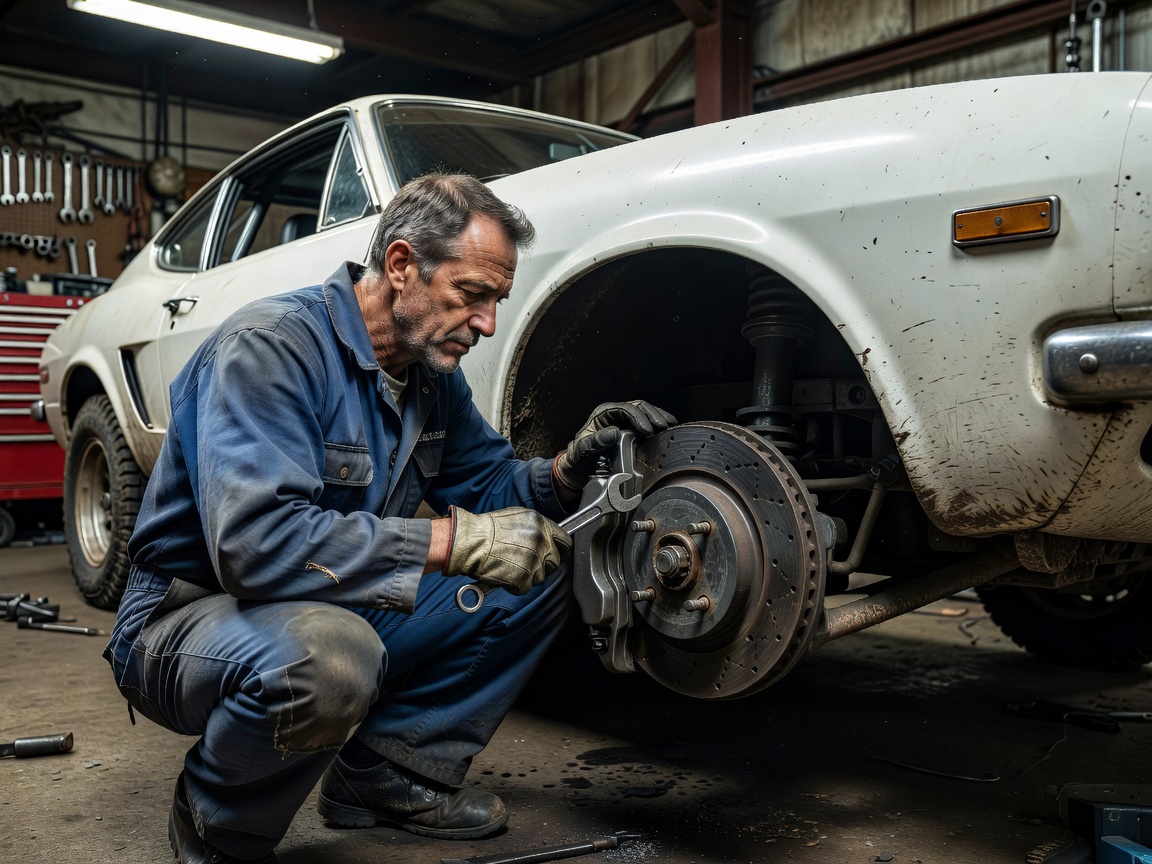
We inspect ball joints, kingpins, idler arms, and tie rod ends using lever checks under simulated load. Wheel bearings are repacked with high-temperature motorsport grease and set with exact end-float tolerances. On braking systems, we check master cylinder stroke, caliper piston retracting seals, and pad friction material thickness. Brake fluid is replaced with fresh high-boiling-point fluid; hygroscopic moisture in old fluid turns into vapor locks on the first long downhill descent.
The electrical harness and driver environment
If you interview fifty vintage rally entrants about their DNFs (Did Not Finish), at least half will point directly to a fifty-cent electrical terminal that rattled loose in the dash. Period cloth wiring, brittle bullet connectors, and ungrounded instrument clusters are historical liabilities.
We rebuild or isolate critical ignition circuits using aviation-grade terminals, heat-shrink strain relief, and clearly labeled relay panels. Driver controls—such as dual tripmeters, mechanical stopwatches, auxiliary high-beam toggles, and fire extinguisher pull cords—must be positioned so they can be activated with four-point harnesses pulled tight and driving gloves on. Driver stamina depends directly on seating support and clear, glare-free instrument visibility in rain or twilight.
The final pre-departure verification checklist
Before the car rolls up the loading ramps of an enclosed transporter, it undergoes a final signed checklist: