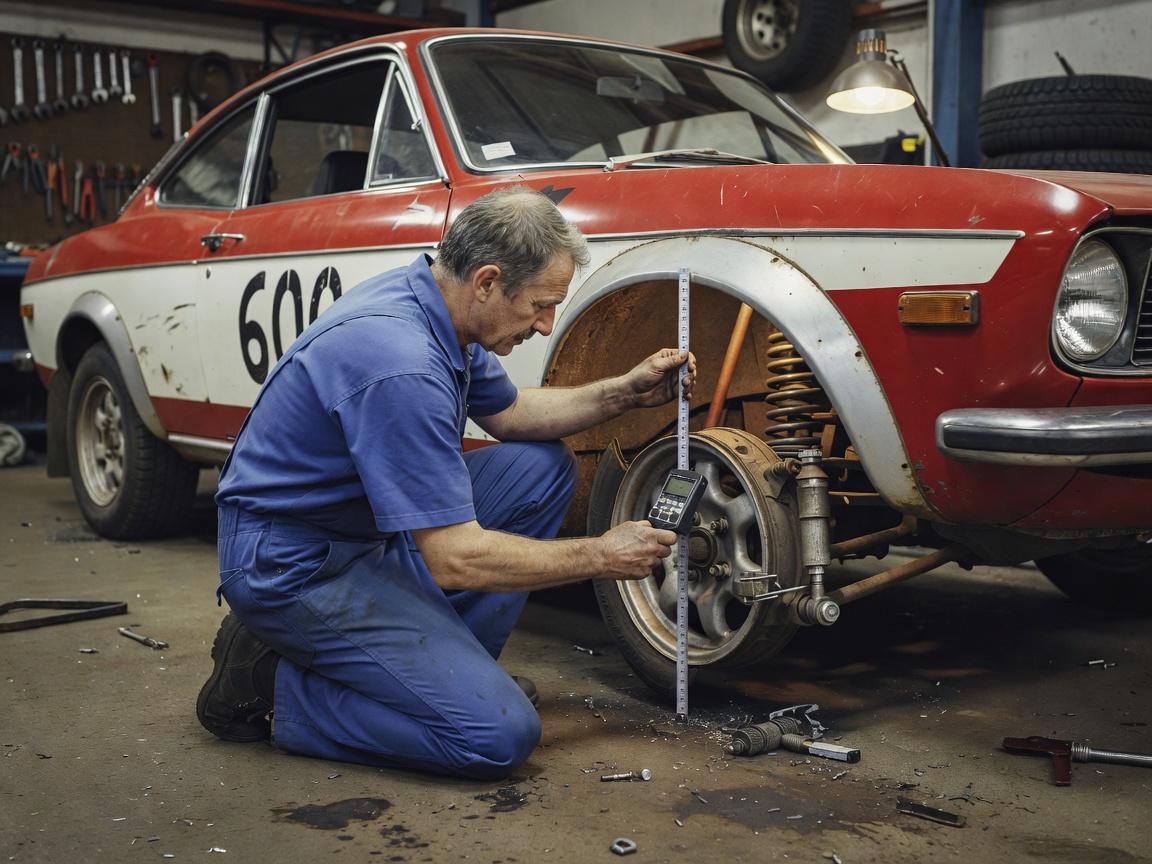
The inspection workflow: Visual checks versus mechanical reality
You can learn a great deal just by walking around a car on level ground with an inspection light, but looks can be deceptive. A panel that sits evenly may disguise an uneven spring rate, while a brand-new tyre can mask a bent stub axle.
Our inspection begins with an unloaded baseline check, followed immediately by corner weighting with driver and navigator ballast in the seats and a half-tank of fuel. We measure cross-weight percentages to ensure the chassis isn’t diagonally twisted. If one diagonal corner is carrying excessive load, the vehicle will brake erratically, diving to one side under threshold pedal pressure and snapping in unexpected ways during transitions.
Alignment concepts: Camber, castor, and dynamic toe
Track racing often rewards aggressive negative camber to maximize grip during sustained lateral cornering. On a classic rally car, however, excessive negative camber destroys straight-line braking stability on uneven asphalt and wears out the inside tyre shoulders during transport liaisons.
We set static camber with suspension travel in mind, ensuring that as the car rolls under load, the tire contact patch stays as flat as possible. Castor is chosen to give reassuring self-centering feel without making the unassisted steering rack excessively heavy during tight hairpin turns. For toe settings, slight toe-in at the rear provides essential high-speed stability over crests, while front toe is tuned to balance turn-in urgency against straight-line dartiness.
Brake balance, pedal modulation, and feel
Modern racing cars rely heavily on high-boost assistance and ABS systems. In historic rallying, you are reliant on direct hydraulic pressure from your right foot. If the pedal feels wooden or inconsistent, the driver loses confidence, starts braking too early, and loses vital stage seconds.
We inspect dual-circuit master cylinder balance bars, checking that front-to-rear bias adjusts freely without binding. We match pad compound friction coefficients to operating temperature windows: fitting a pad that requires 350°C to bite on an entry-level road regularity rally means cold corners will have almost zero stopping power.
Surface adaptations: Wet tarmac, broken asphalt, and loose gravel
Setup must mirror the surface reality of the rally. There is no point setting lap records in dry conditions if the rally runs at night in misty rain:
Tarmac & Alpine Passes
Slightly firmer rebound damping controls body roll, but ride height must maintain sufficient bump travel to swallow road seams and drainage gutters. Tyre compounds must warm up quickly during liaisons so grip is available immediately at the stage start control.
Gravel, Mud & Rough Tracks
Raised ride height to protect the sump and fuel lines, softer spring rates to allow compliance, disconnected or softer anti-roll bars to maximize individual wheel articulation, and open-tread tyres that clear mud rapidly.
Driver cockpit ergonomics and setup documentation
Fatigue is the enemy of consistency. If the driver is straining to reach third gear or the navigator cannot read the odometer without tilting uncomfortably, mistakes follow.
We adjust seat rake, pedal pad spacing (crucial for heel-and-toe downshifts), steering column angle, and auxiliary lighting switches to fit the actual crew. Once the car is dialed in, we record every single dimension—damper clicks, tyre pressures, ride heights, toe measurements, and corner weights—in a dedicated physical and digital chassis logbook. When conditions change on event day, you know exactly what baseline you are starting from before adjusting a single click.